~Gwendolyn C. Natusch, B.S.Ed., M.Ed., MSW
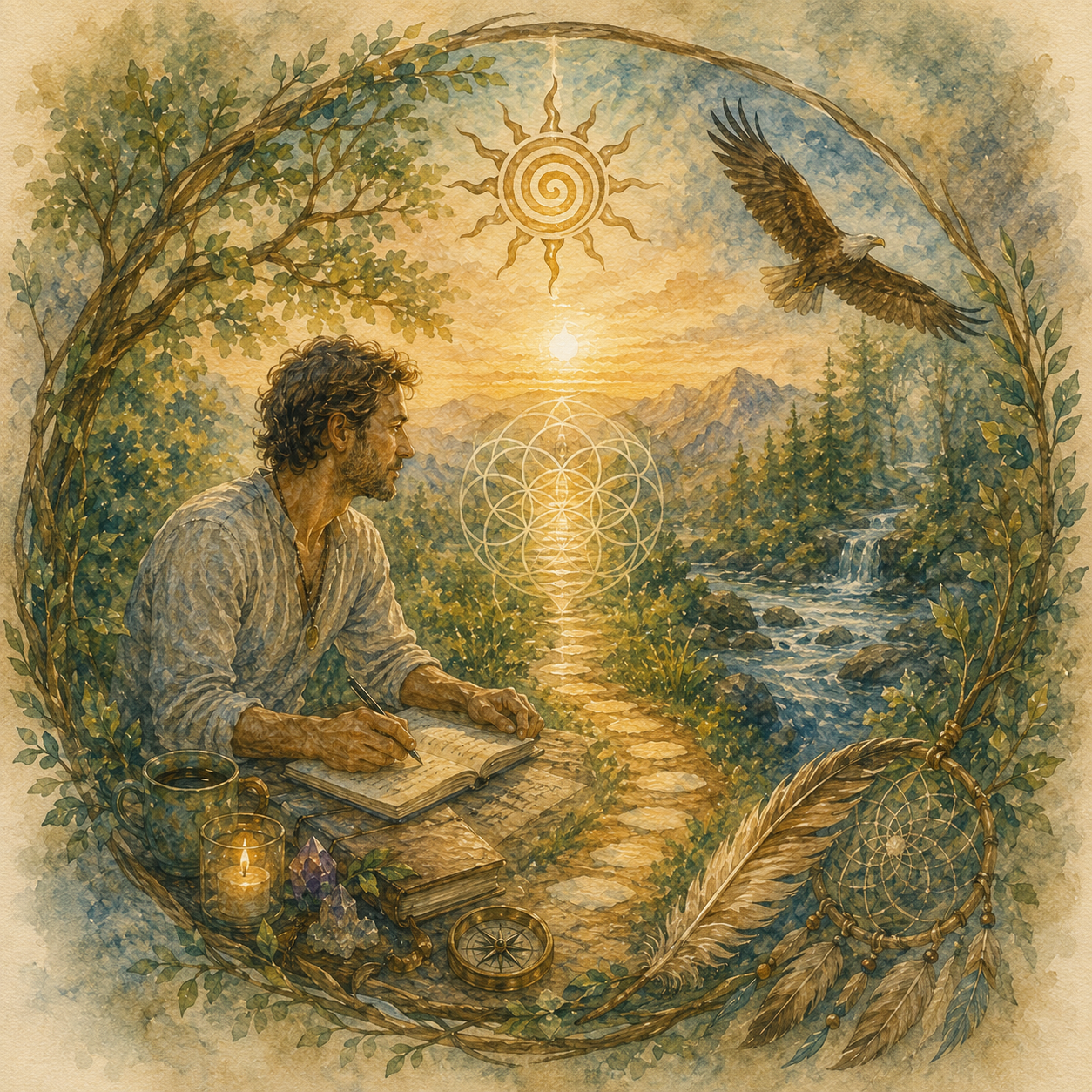
Long before we can explain what is happening within us, we often experience it as an image, a feeling, a color, a dream, a memory, or a symbol. The deeper self does not always communicate in tidy sentences. Sometimes it gives us a river, a locked door, a wounded animal, a storm, a tree, an empty space, or simply a color that carries more emotion than words can hold. The Circle Within grew from this understanding: when we give the inner world a place to become visible, we can begin to see ourselves differently.
Why the Circle?
The circle is one of humanity’s oldest sacred forms. It appears in the sun and moon, seasons, tree rings, medicine wheels, ceremonial gatherings, and the cycles of birth, death, and renewal. Psychologically and symbolically, the circle offers two things at once: a boundary and a center. The boundary creates a container for experience. The center asks us to look beneath the surface and consider what is truly asking for our attention.
The circle does not require us to be peaceful, balanced, or “healed.” It can contain opposites: fear and courage, grief and gratitude, wounding and wisdom, separation and belonging. Even an image that feels chaotic, empty, dark, or unfinished may tell an important truth.
Carl Jung and the Sacred Circle
Swiss psychiatrist Carl Jung became fascinated by spontaneously created circular images, or mandalas, appearing in dreams, visions, spiritual traditions, and artwork.
Jung believed the mandala could represent the Self, the larger wholeness of who we are, including not only the conscious personality but also the unconscious, forgotten, emerging, contradictory, and unrealized aspects of ourselves. He associated these images with individuation, the lifelong process of becoming more fully and authentically ourselves. In this sense, a circle can become an inner map.
What have I placed at the center? What have I pushed toward the edge? What is protected? What feels divided? What is trying to emerge? No symbol has only one predetermined meaning. A river may represent freedom for one person and fear for another. A snake might carry associations with transformation, danger, healing, wisdom, or something entirely personal. The question is not simply, “What does this symbol mean?” but rather, “What is this symbol doing here, in my image, at this moment in my life?”
Circle Art as a Waking Dream
This is where art becomes especially powerful.
An emotion that exists only as an uncomfortable feeling can be difficult to understand. But when that emotion becomes a color, landscape, creature, wall, pathway, storm, or shape, we can step back and look at it. The artwork becomes both expression and witness.
Artistic skill is unnecessary. In fact, trying to create the “right” picture can interfere with the process. The invitation is to allow the image to emerge intuitively and then approach it with the same curiosity we might bring to a dream. With the Shamanic Journey we enter the Image and the experience of shamanic journeying adds another dimension.
Journeying is an intentional spiritual practice in which repetitive drumming and focused intention help us enter a receptive state of consciousness. Within a journey, people may encounter symbolic landscapes, animals, compassionate guides, ancestors, memories, sensations, or messages that arise through image and direct knowing.
Within The Circle Within, the first artwork gives form to our present perception. Then we journey. Instead of intellectually trying to “solve” the first circle, we can enter into relationship with it. We may ask: What is this symbol protecting? What have I not yet seen? What does this part of me need? What belongs to the past rather than the present? What wisdom or medicine is available now?
The journey can transform a static image into a living landscape. A frightening animal may speak. A wall may reveal why it was built. A guide may introduce a new pathway, color, symbol, or possibility.
Healing Through Perception Shift
Healing does not always require changing what happened. Sometimes it begins by changing our relationship to what happened. A perception may shift from “I was powerless” to “I survived, adapted, and now I have choices.” Fear may be recognized not simply as an enemy, but as something that once tried to protect us. A wound may remain part of our story without continuing to define our entire identity. A perception shift does not deny pain or cover it with positive thinking. It allows another truth to stand beside the original one. The past does not change, but the place it occupies within us can.
This new relationship becomes the foundation for the second circle. The second image is not intended to portray a perfect ending. Instead, it may reveal greater compassion, choice, strength, understanding, spiritual connection, clearer boundaries, or peace.
The first circle says this is how the experience lived withing me, ” The journey asks, “What else is true?” The second circle answers, “This is the new relationship that is becoming possible.
hat is the heart of The Circle Within. We create not because everything can be explained, and certainly not because eveything must become beatifiul. We create because sometimes something within us has been waiting a very long time for a language of its own and within the shelter of the circle, it may finally begin to speak.


